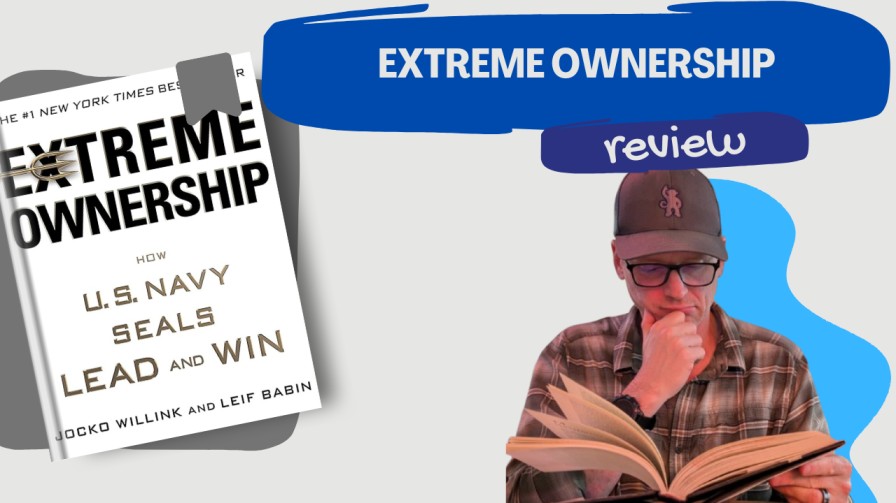
Extreme Ownership is one of those leadership books that quietly sits on your shelf for a while. Then you finally get to it, and you realize it was probably recommended for a reason. The core ideas feel almost painfully direct, but in a way that actually helps: they make leadership less mysterious and more actionable and when blended with other strong methods you’ve got a strong foundation.
Jocko Willink, co-written with Leif Babin, frames the book around what he believes every leader must internalize: your team’s failures are your responsibility. Not “mostly,” not “in part,” and not with excuses attached. The book is built like a system, with combat lessons, leadership principles, and real business application.
If you’re more into video, you can check out the video overview here.
The Core Argument: If Something Went Wrong, It Traces Back to You
Here’s the thesis, compressed into one sentence: every failure on a team traces back to the leader.
That can sound harsh until you notice the logic. If your people are confused, undertrained, blocked, or drifting, you are the person who should have built the conditions for success.
So the “extreme ownership” mindset is not about blaming yourself for everything in an emotional way. It’s about doing something more useful:
- No qualifiers when it comes to accountability. If communication was unclear, you didn’t communicate clearly enough.
- No excuses when someone underperforms. If training or guidance was missing, you own that gap.
- No passive frustration about resources. If you didn’t secure what you needed from leadership above you, you didn’t make the right case (or didn’t advocate effectively enough).
The payoff is huge. When responsibility flows upward, you stop waiting for someone else to fix the problem. You build a plan, adjust your leadership, and improve your environment. And that change then improves your team.
How the Book Is Structured (and Why It Works)
What I appreciate is how cleanly the book is organized. It runs on a simple architecture:
- 12 chapters, each focused on a leadership idea
- Each chapter is split into three sections:
- A combat story (drawn from operations like Ramadi and SEAL team experiences)
- The leadership principle itself
- Business application, showing how the principle translates to corporate and civilian leadership
The combat stories do a great job of proving these aren’t just theories. They establish where the lessons come from and why they matter. The business stories are sometimes less gripping (the stakes are different), but they still help you see the principle in an environment most of us actually live in.
All Responsibility Flows Upwards: What That Looks Like in Real Leadership
This idea can be boiled down further: the leader must own everything in their world.
That includes the uncomfortable stuff:
- Acknowledging mistakes without spiraling into self-punishment
- Admitting failure clearly
- Turning that admission into a plan to win next time
The book also gets into an additional layer that many people skip: ego management. Healthy ego is not the enemy. Leadership requires confidence. But ego becomes poison when it blocks honest assessment, prevents learning, or turns accountability into defensiveness.
And yes, the book discusses the practical realities leaders face: managing underperformance, handling discipline, and dealing with team failures without pretending they are somebody else’s problem.
Extreme Ownership Meets Feedback: The “Tell People” Problem
One of the most useful complements to extreme ownership is honest feedback culture.
In another leadership book, Radical Candor, Kim Scott emphasizes that if your direct report is underperforming and you do not tell them directly, then the failure is yours. That’s not cruelty. That’s relational necessity. In other words: silence becomes a form of neglect.
There’s also a tricky temptation on the other side: people fear being too aggressive. They worry about sounding like an “asshole.” But the underlying point is still practical. If you never give critical feedback, you may feel kind, but you’re not doing your job.
Balance matters. Extreme ownership says you must take responsibility. Candor says you must communicate it clearly. Together, they force leaders to both:
- care personally about people
- challenge professionally so standards don’t slip
Standards Are Set by What You Tolerate
If you want one leadership principle that sounds simple but can have big real-world impacts today, then consider:
Standards are not what you preach. They’re what you tolerate.
It’s easy to put “quality” or “excellence” on a poster. It’s harder to enforce it in the real world, especially when deadlines hit and people get tired. But the standard becomes real the moment you tolerate (or don’t tolerate) shortcuts.
I also loved the idea of keeping processes simple and implemented regularly. If you want alignment, you need repeated execution of the standard, not just occasional reminders.
Debriefs and Feedback Loops: Learn Faster Than Your Competitors
One of the most practical parts of the book is the emphasis on debriefing after operations.
After an engagement, teams don’t just move on. They examine:
- What went right?
- What went wrong?
- How can we adapt our tactics to be more effective next time?
This resembles ideas from business decision-making frameworks too. For example, Decisive (Chip and Dan Heath) describes a structured process for making better choices, and the spirit is similar: widen options, test assumptions, and prepare to be wrong.
The bigger point is that systems beat stories. If you rely on intuition or only tell a narrative after the fact, you improve slowly. If you systematically analyze what happened and then adjust behavior based on that analysis, you get better faster.
There’s also a historical nuance worth noting. Some military critiques argue that institutions sometimes fail to build strong feedback loops at scale (Hackworth in About Face), so mistakes repeat across rotations. Even if your organization has gaps, your personal debrief discipline still matters. It benefits you directly, and it can influence the people around you.
Decisiveness Under Uncertainty: Act, Then Adapt
Another key theme: you will never have perfect information. The leader’s job is to make decisions anyway, then respond quickly when reality updates.
The book’s message here is classic but still incredibly relevant: there is no 100% right solution. You should be comfortable acting without certainty, then adjusting as new information appears.
Type One and Type Two Decisions
A helpful way to think about this is the idea of decision “reversibility.”
- Type one decisions: more serious, harder to undo, deserving more analysis and slower thinking.
- Type two decisions: low-stakes, reversible, and often can be handled quickly. If it’s wrong, you can pivot.
That’s why trying something like reading the first chapter of a book, rather than endlessly debating whether it’s “worth it,” is often the smarter move. If it turns out to be a bad bet, you learn and move on.
Use Speed, but Use Process Too
Jocko’s approach isn’t “rush blindly.” It leans on structured decision-making. The spirit is similar to the well-known OODA loop: Observe, Orient, Decide, Act.
And if you’re doing the structured analysis part, you want to:
- Widen options (don’t lock into the first idea)
- Reality test assumptions (especially the ones your ego likes)
- Attain distance (reduce emotion-driven thinking)
- Prepare to be wrong (plan how you’ll respond if the decision fails)
A useful mental model is to match approach to consequence. Be fast when the decision is reversible. Be more deliberate when it is irreversible.
Discipline Equals Freedom (Yes, Even When You Don’t Like the Sound of It)
This section lands because it’s both practical and slightly uncomfortable. Discipline can feel restrictive. But the book’s underlying argument is that discipline removes chaos.
If you have a daily list, a recurring process, and a system for getting important things done, you reduce the constant worry of “Did I miss something?” or “Am I going to get called out later?”
That means you can spend more energy doing what you actually want: deep work, relationships, long-term projects, health, and learning. Discipline buys you mental space.
Still, balance matters. You can be too rigid, or ignore parts of life that need attention. The point is not blind control. It’s self-awareness about whether your routines are helping you or slowly pulling you out of alignment.
That’s where reflection shows up: Are you doing what feels right, or are you just optimizing work while neglecting life? The healthiest leaders build systems and also adjust them when the signals shift.
A Worthwhile Synthesis: Accountability Plus Care
One of the strongest “together” insights from the book is this: accountability without care becomes harsh. Care without accountability becomes soft.
Extreme ownership provides the accountability engine. Radical candor helps fill in the human part: dealing with real people, real emotions, and the reality of running a business where outcomes matter.
In practical terms, that can sound like:
- Hold people to standards without pretending you don’t care.
- Give direct feedback early, not after performance has already degraded.
- Make the organization’s needs non-negotiable while treating people like people.
Final Take: Why This Book Is Worth Your Time
Extreme Ownership earns its reputation. The structure is simple enough to move through quickly, but the lessons are dense enough to stick. It’s also unusually transferable. Military leadership becomes organizational leadership. Then organizational leadership becomes personal leadership habits.
If you lead people, manage projects, run a business unit, or even just want to stop repeating avoidable mistakes and be more accountable to the person that matters (you), this book is one of the clearer maps out there. It doesn’t let leaders hide behind explanations. It gives you a framework to build better outcomes through accountability, standards, feedback loops, and decisive action under uncertainty.
Check it out on Amazon here, or via your library here.